Showing posts with label Planning for School. Show all posts

Monday, July 11, 2011

Simon Says Verbs

A favorite little game of ours is Simon Says Verbs.  I use it to teach my children and English students how to recognize an action verb.

The teacher plays the part of Simon and tells the students to...

DANCE!
KICK!
SING!
or SLEEP, shhhh....
How long you wait before giving the next verb
after this one is entirely up to you!
As you play, mix in words from other parts of speech, like nouns, adjectives, and prepositions (it is advisable to avoid linking verbs like am, is and are).  Tell them, "Simon says to beautiful" or up or apple. 

Invariably, when you say apple, some too-smart-for-his-own-good person will do this...


Politely remind Mr. Smarty that he is eating and not "appling".  Then give him the stink eye. 

That should take care of it.

As you work your way through the list of words, have them yell "ACTION VERB" if they are able to do what Simon has commanded or "something else" if they cannot do it.  Alternately, they can cheer and sing the Schoolhouse Rock classic That's What's Happenin' for the verbs or boo and hiss at the impostors.

Adding culture and class to your school day...you're welcome.

As you progress through the game, write each true action verb on an index card and tape it to a wall or pin it to a bulletin board.  For a few days after your game, have your children remain on the look-out for action verbs.  If they recognize one in everyday conversation, let them write it on an index card and add it to the verb wall.

Simon says...
Happy Learning!
Dawn

Friday, June 17, 2011

My Favorite Resource This Week: Circle the Date Planner

Favorite Resource This Week
Please visit Learning ALL the Time
for links to more favorite resources!

My favorite resource this week is the simplest, yet most effective, organizational tool I have ever used with my children. It is the Mead Circle the Date Planning Notebook.

I bought one notebook for each boy at Wal Mart. I cannot remember the price I paid but feel certain it was less than $10 per notebook.


Here's how we use them:

  1. On Fridays, I collect the notebooks and fill in the pages for the up-coming week. I circle the date on each needed page. This is normally five pages (one each for Monday-Friday); however, if we plan to take a day off, I will only circle the date on the number of pages needed for active school days.
  2. I write in specific page numbers and specific instructions for independent work and a note that says, "See Mom" for lessons we need to complete together.
  3. I write in daily chores.
  4. When I have filled in all the assignments, the boys place their planners in a "special spot" on their desks and work down their to-do lists each day.
  5. Before I declare each school day finished, I read down each list, make sure I have graded all independent work, that all together work is complete, and inspect the quality of their completed chores.  If everything is done well, they are FREE! 
  6. When they have finished their Friday work, they bring their planners to me for a conference during which we finish step 5 for that day and restart the cycle with step 1, preparation for the next week.

Here's what I like about these planners:
  1. They are available in different colors, so each boy has his own. I know the red one belongs to Wilbur and the black one belongs to Orville (as do they).
  2. The pages are large with lots of room to write...cause I always have lots to say (and write)!
  3. It is spiral bound so we can easily keep the notebook open to the page for the day and keep all the old pages as records of what we have done. (Can anyone say easy end-of-the-year record?)
  4. The circle-the-date feature means that we don't "lose" any pages because they are date specific. I don't need to write in instructions for Saturdays and Sundays or days that we are on a school break. All those pages would go unused in a date-specific planner.
  5. It has made the school day run MUCH MORE SMOOTHLY! Really!!


Here is the best deal I could find online. It is not the exact same planner that we use, and I don't think they are available in different colors. I suggest checking your local Wal Mart or office supply store before buying online, however, should you buy through the link above, Amazon will pay me a small commission. Thanks! (I have not received any other compensation.)

Happy Date Circling!
Dawn

Wednesday, April 20, 2011

Closing Out the 2010-2011 School Year

At the Olive Plants Academy, we are just a few weeks from the end of the 2010-2011 school year!
Unbelievable!

Before school began, I created a page on which I listed our plans for the year.  I just updated the page so you can read an overview of our year and how our curricular plans panned out.

Click here to be redirected to the updated Our Academy page and read all about it.

I will reveal our plans for 2011-2012 very soon!

Happy Planning!
Dawn

Tuesday, August 18, 2009

Plan-It School Series: The Conclusion!

The plans were in place.

The classroom was in order.


The children were excited.

Mom was well-rested.

And Dad was raring to go.


The first day of the 2009-2010 school year was picture perfect at the Olive Plant house. I opened my planner at 8 a.m. and glided from one lesson to the next.


There was singing.

There was dancing.


There was reading and discussing, writing and drawing. It was like a big, bright ray from heaven was shining down on our little classroom.


Then it happened.


Road crews stopped in front of our house at 10 p.m. and worked until 6 a.m. Tuesday, Wednesday, and Thursday.


We thought they were finished until they came back for an encore performance the following Monday and Tuesday.


The walls vibrated.
The furniture rattled.


Beeping sounds echoed up and down and up and down the street all night. Lights flashed through the windows so frequently that we felt like we were at

a disco!

In other words, there was no sleeping at our house for five full nights.

It is so nice when our days come together perfectly, and we can easily follow our plans just as we wrote them. From time to time, there are days like that, and it feels good to experience the fruit of our labor. However, these are not the days for which lesson plans are really intended.

Lesson plans serve a better purpose on those days when life is hard. When the unexpected brings me down, they serve as a reminder of the important job God has given me. They remind me that what I do or don't do today will affect tomorrow. They prompt me to "get over myself" and to pray for the grace to do what God wills. Sometimes that means doing more than I thought possible through Christ who is my strength. Sometimes it means relinquishing that which I thought was so important. Some days I want to give up but am reminded that God's grace is sufficient, and others, I must lay my plans at the Throne of Grace and pray, "Not my will but yours."

So as I end this series on lesson planning, I want to encourage you to be mindful of the fact that planning is not about being perfect. It is about being prepared. When the hard times come, don't feel defeated. Don't look at your plans and think all is lost because things didn't turn out exactly as you hoped. Instead remember that "man's mind plans his way, but the Lord directs his steps." (Prov 16:9)

Planning is prudent. "The plans of the diligent lead surely to abundance, but everyone who is hasty comes only to poverty." (Prov 21:5) However, complaining, particularly because our plans are interrupted, is rooted in pride.
"Come now who say, 'Today or tomorrow we will go into such and such town and spend a year there and make a profit'- yet you do not know what tomorrow will bring. What is your life? For you are mist that appears for a little time and then vanishes. Instead you ought to say, 'If the Lord wills, we will live and do this or that.' As it is you boast in your arrogance. All such boasting is evil." (Jam 4:13-16)

Now that they are complete, let's not boast in our plans. Instead let's start each day with the words "Lord willing" and end each one with gratitude for all He has given us and done for us.

Thank you for reading the Plan-It School series. I am praying that the Lord will bless your hard work this school year and prosper you and your family for His glory.

Blessings,

Dawn
*Photo credits: from http://www.freefoto.com/ as marked, all others (excluding #1-3 from http://www.photobucket.com/

Thursday, July 9, 2009

Plan-It School Series: Organizing Supplies

Caution: You are about to enter the Disorganized Zone. In this sector of the universe, craft supplies run amuck. Materials for science experiments attack the unsuspecting people who open pantries. Messes spread like a fungus. And scissors are lost in the vast cosmos of God's creation, never to be held by human hands again. Enter if you dare….

Episode I: The Hunt for the Red Pipe Cleaner

The scene opens with Homeschool Dawn, Orville, and Wilbur seated at the kitchen table, unaware that they are about to be transported to The Disorganized Zone.

HSD: Boys, today I want you to use the craft supplies on the table to create a 3-D model of a caterpillar's metamorphosis into a butterfly. Each of you has a shoe box…

HSD looks at the table. There is one shoe box, but she does not see the other one.

HSD: Boys, did one of you move the shoe box?

O and W: No ma'am.

O: I have not seen a shoebox except for the one here on the table.

W: I don't even know what a shoebox is.

HSD: Okay, let's pause for a minute and go get another shoe box.

Our three characters get into the van and drive to WalMart. After successfully begging for a shoebox, they return 45 minutes later.

HSD: Now, you both have a shoebox. I want you to cover it with construction paper… now where did the paper go?

HSD looks on the table, in the cabinet, in the storage baskets in the classroom, in the closet, on her desk, and finally under the bed.

HSD: A-ha! Here it is… cover your box with construction paper.

W: Mommy, I can't get the paper to stick.

HSD: Wilbur, sweetie, that is because you have to use some glue. Did I not give you some?

W: No.

O: I don't have any either.

HSD looks for the glue. She finds one bottle that is empty and another that is mostly full. However, the cap on the full one was left open and the glue inside has hardened. She pops the top off the bottle and digs through the crusted glue mass along the opening. She evidently applies too much pressure because the liquid glue breaks free and squirts out onto her face, hands, and shirt. After cleaning up, HSD pours some glue into a plastic bowl and goes to the craft closet for two paint brushes.

HSD (while digging through mounds of craft sticks, art paper, bottles of paint, and craft pom poms): Now, where are the paint brushes?

W: I know, Mommy.

Wilbur opens his desk drawer and proceeds to pull out crayons, markers, dried-up glue sticks, stickers, and water colors that have been used until all the palates are black, but no paint brush.

HSD: I guess it's back to Wal Mart.

20 minutes later they return with paint brushes and more glue bottles. After the boys glue the construction paper to their boxes, HSD continues with the next step.

HSD: Now take your red pipe cleaner and cut it into four pieces using your scissors.

W: I don't want to clean the pipes. It's scary under the sink.

O: Wilbur, she doesn't mean the pipes under the sink. She means a pipe like Grandpa's. Mom, I thought Grandpa's pipe makes you cough. Is that why you want us to clean it?

HSD: No one will be cleaning any pipes, kitchen or otherwise. Pipe cleaners are the different-colored, fluffy sticks that we use in crafts. You should each have a red one on the table. Now, where did they go?

HSD returns to the craft closet. When she opens it, all the paint bottles she moved in her previous search roll out and land on her feet. The papers and pom poms start to slide, and she quickly throws herself against the shelves, blocking the landslide. While pushing against the mound of supplies with the left side of her body, she reaches around with her right arm and pushes everything back inside the cabinet.

O (from the kitchen): Mom! I found the pipe cleaners.

HSD (rubbing her sore arm, side, and feet): Where were they?

O: Under the table.

HSD: *sigh* Okay, cut your pipe cleaners into four pieces.

W: How do we cut them?

HSD: Carefully use your scissors to do it.

O: I don't have any scissors.

W: Me either.

HSD: Where are they?

O and W: I don't know.

HSD(exasperated): Oh, never mind.

When I read this scenario to my husband, his reaction was to ask (in disbelief) if this had ever really happened. "Well, yes and no" is my honest answer. This particular situation is fiction but it is based on reality. I have spent many hours looking for paper or scissors or paint brushes. I have made numerous trips to Wal Mart in the middle of the school day to purchase a forgotten supply. I have been injured by supplies toppling out of an over- crowded cabinet. Worst of all, many a well-planned activity has been abandoned because I did not gather the needed supplies ahead of time.

I already mentioned my best piece of advice for new homeschooling moms in this post. The second most important thing I would advise you to do is make a list of what you need before each and every unit and then check it twice.

Before school begins, I look through all my teacher's guides and plans that I have written for my first unit and make a list of all the materials that will be needed to complete it. I try to keep a stockpile of certain materials; however, I keep it to the basics like construction paper, crayons, and paint (we LOVE to paint). Be careful when making stockpiling decisions because you do not want a cabinet full of things that you "might need".
To avoid the landslides, I store these materials in shoe boxes, trays, crates, or any other inexpensive or free storage container I can find. I keep these inside a cabinet and do not look for pretty containers. Cheap or free and durable is what is important. I label the outside of the boxes so I know the exact contents. After I have my list together, I check off anything that I have plenty of on hand. If I see that I am running low on an item, I leave it on the list so that I can restock.

I have taken two different approaches to the next step. The first two years I homeschooled, I wrote out a weekly shopping list for school materials and placed each list in my planning folder in the front of the section for the week before I would need the supplies. Each week, I removed the list and added it to my grocery shopping list. I also wrote books I would need to check out from the library on this list and made my library stop on the way to the store.

I found this approach did not give me time to get materials organized and I would still find myself scrambling at the last minute for something I had forgotten or misplaced. Two years ago, I started buying everything that I need for an entire unit in one shopping trip. I plan this shopping trip for a day that I have time to organize the materials immediately upon my return home. I put general items, like construction paper, that will be used during multiple lessons in the correct storage bins in my school cabinet. I put items that will have a single use in a bin that is numbered according to the week it will be needed. I store all science supplies in the kitchen and have dedicated one shelf for those things… with the exception of common, household items like baking soda. Those are easy to find when needed and won’t send me on a scavenger hunt during school hours, so I leave them in their normal spot.

The 2009 Schoolhouse Planner has a shopping list with room for writing in schools supplies. There is also a form to help you keep track of library books.

To keep messes under control, I have arranged the boys' desks front-to-front so they serve as an individual work station or as a shared space for projects. Each boy has his own garbage can at his desk and is required to check it daily and empty it as needed. I also have an old, king-sized sheet that when folded covers the entire workspace and prevents paint, glue or other messes from damaging the desks. The paint has stained it, but I can throw it in the washing machine when finished to wash away the messy, sticky remains of a project. If we will be working on a painting project for multiple days, I spread newspapers beneath the sheets as the paint splatters will soak through if left to sit. The sheet over the newspapers prevents the boys from getting ink on their fingers (and arms, face, the furniture….).

Make sure you buy plenty of pencils, erasers, crayons, markers, and glue at the beginning of the year, too. Our state has a tax-free shopping weekend. I have found that the week before is the best time to buy though. The back-to-school sales usually run during that week, at least in my area, and the prices are so low that even after paying tax, it is a much better deal. I keep a basket on my desk for storing extras of these items close at hand and keep a can of pre-sharpened pencils there, too.

How do you stay out of The Disorganized Zone? Feel free to share your tips, too!

Blessings and Happy Planning!


Return soon for Plan-It School Series: Preparing for Household Responsibilities

Wednesday, July 8, 2009

Plan-It School Series: Preparing for Assessment

The principal of the school where I taught always said that there are three keys to good teaching…

Assessment…

Assessment…

Assessment….

When I say "assessment", what is the first thing that comes to mind? A written test, right?

Multiple choice, essay, fill-in-the-blank, and even standardized tests are what most often qualify as assessment. Though it is true that these are types of assessments, evaluating what your child has learned is an on-going process. It begins with pre-assessments and continues each day through several forms of evaluation.

Pre-assessment occurs at the beginning of a new unit or before teaching a new skill. It can be formal. You give your child a work sheet of problems or questions that pertain to the material to be covered. It can also be informal… a simple discussion in which you determine what your child already understands. A KWL table is a great way to begin the assessment process. Before you begin a new unit of study, your child fills in the K column with the information he already knows. If your child can produce this information in this way, you can feel confident that he has mastered it and that you do not need to teach it.

I find questioning to be the best form of on-going assessment. It is simple yet effective. At the end of a lesson, take a minute or two to close out the lesson. In Setting the Stage, I compared the set of the lesson to an introductory paragraph of an essay. Similarly, the closure of a lesson is like the closing paragraph of an essay. After writing the body, a good writer takes one last paragraph to summarize and end his presentation or argument. In the closure of a lesson, the teacher takes a few minutes to ask questions that pertain to the lesson or reading or activity. This informal assessment lets you know what your students grasped and where they need a little more work.

Writing is another great way to assess. Remember those dreaded essay tests we took in school? That is one way to assess through writing; however, anything that you have your child write that demonstrates a knowledge of the content area can be used. If you have your child journal or notebook, allow him to write about what he is learning. Younger children may only be required to write a sentence or two. The older the child, the more he should be required to write.

Sometimes a more formal essay is appropriate. Younger students can be asked to write a few sentences on a topic. Middle aged children can be assigned a three-point essay while older students must write a research or term paper. If you assign a writing project as a means of evaluating what your child has learned in a different content area, it is advisable to give two grades… one for the writing quality and one for the content. The content grade can be averaged in with other grades in that particular subject. You would not want your child to receive a poor History grade because he failed to use commas properly. Likewise, you would not want him to receive a good History grade because his grammar was good while his content was lacking. Rubric grading is a great way to grade writing. The rubric can be generated to include both content and style or two rubrics can be used, one to assess writing quality and one to assess content.

Alternative assessments offer many options for closing out a unit of study. I love portfolio assessments. They help me stay organized during the school year and end up as keep-sakes later. They also make for a good place to keep attendance, standardized test results, and other records. You can read about how we organize a portfolio here.

Performance-based assessments ask students to put in action what they have learned. I observed a teacher once who assigned her class the task of creating a restaurant… not a pretend one, a real, functioning restaurant within their classroom. They had to seek out investors for start-up money, create a menu, hire a chef, set the classroom up to function as a restaurant, shop for food, décor, furniture and other supplies, send out invitations to the restaurant's "opening (and only) night", and serve as the restaurant's wait staff that evening. They put to use skills they had acquired in math, writing, health, economics and art. The teacher graded their performance in each of the core subject areas, and the attendees, including a restaurant reviewer for the local paper, evaluated their overall performance.

I have had my children complete a few simpler-to-pull-off performance-based assessments. They have created a grocery store which sold play food to the stuffed animals of our house. They created a society for their plush toy birds and organized the Birdieland government. They have written and performed short plays (at home with family members as the audience). All of these fall into the category of performance-based assessments because several skills from different content areas were put into practice. The success of their endeavor was measured by how well they used what they had learned.

The form of assessment I use most often is project-based. Technically, project-based learning is more of a style of teaching, and the projects are assessed with a checklist or a rubric. However, overseeing a project always gives me a clear understanding of my boys' abilities. A good project usually integrates skills from many different subject areas. It also involves organizational skills. Each time my boys complete a project, I am able to assess how well they can take a large job and break it into smaller steps. In the early years, I had to think through every project for them. Now that they are 4th and 5th graders, they can organize their work themselves and only need guidance from me. We complete so many projects that I compiled a list of 101 different project ideas.

So, let's review. What did you learn in this post? What is a portfolio assessment? What are performance-based assessments? What assessment form can you use to grade both writing and projects? Did I just make you look back over this post? Ah Ha! This, my friend, is what we call closure! :-)

Please post your answers as a comment and feel free to leave any tips you have, too!

Blessings and Happy Planning!


Return Soon for the next article in the Plan-It School Series.

Saturday, June 20, 2009

Plan-It School Series: Organizing Materials, Part Two

It is now time for our feature presentation….
 
At School with the Olive Plants
 
The scene begins with Homeschool Dawn, Orville, and Wilbur seated at the kitchen table.
 
Homeschool Dawn: Orville, it is time for math. Please, get out your textbook.
 
Orville: Is that the yellow book?
 
HSD: No, Orville, that is the phone book. Your math textbook is green. Where is it?
 
O: I'm not sure. I think I put it in my bedroom.
 
Orville leaves the kitchen and searches his room for the elusive math textbook.
 
HSD: Wilbur, let's work on your spelling while Orville finds his math book. Please get out your spelling book.
 
Wilbur (after looking through a mound of assorted workbooks, Lego magazines, and drawings of birds): I don't see it anywhere.
 
HSD: Well, where did you last have it?
 
W: I don't know.
 
HSD: Wilbur, please go look for your spelling workbook.
 
Wilbur leaves the table, and Orville returns.
 
O: Mom, I'm not sure if I found it. Is it one of these?
 
Orville sets a pile of objects in front of HSD. She examines each, one at a time.
 
HSD: (after looking at the first object) No, this is your math workbook. You need the text today. (while holding the second object) No, this is your brother's math textbook. Wilbur, come get your math book, please.
 
Wilbur enters the kitchen with Legos in hand.
 
HSD: Wilbur, are you looking for your spelling book?
 
W: Yes.
 
HSD: Why do you have the Legos then?
 
W: I built a book-finding machine. It's helping me.
 
Wilbur takes his math book and he and the machine resume their search. HSD holds up the next item in Orville's stack.
 
HSD: No, this is The Chicken Sisters.
 
W (from the next room): The Chicken Sisters? I love that book. Will you read it to us, pleeeeaaase?!
 
HSD: No, keep looking for your book.
 
HSD looks through the remaining items in Orville's stack. There is a Taco Bell receipt, a sock, two crayons, a potato, and the Holy Grail, but no math textbook.
 
HSD: Orville, what did you do with your book?
 
O: Mom, I just can't find it. Maybe Maggie (the dog) ate it.
 
Wilbur returns to the kitchen with an even larger Legos construct in hand.
 
W: Mom, I couldn't find my spelling book so I built an even bigger machine. Look, it has a scope on top, wheels for bumpy terrain, and a super word sensor. The best part is the spy button. When I press it, Word Girl will fly through my bedroom window and spell my words for me.
 
HSD looks at the clock. It is four o'clock and time to start dinner.
 
HSD: I guess we'll have Saturday school again this week.
 
O: But Mom… it is Saturday.
 
HSD: *sigh*
 
Okay, so my little drama is a bit over-the-top; however, it is truer-to-life than I would like to admit. I found early on that I could not keep a shared-space school arrangement organized. To eliminate some of the confusion, each boy now has his own desk with a built-in storage cubby. Any of their current books or workbooks is kept in it. They also have three-ring folders for several subjects. Before each nine-week unit begins, I photocopy all worksheets and notebooking pages that they will need and organize them in these folders. These folders also stay in this cubby.
 
On our bookshelf, I organize the books not currently in use but that will be needed later in the unit. In previous years, I have taught thematically which required several books per student. This year I am switching to Tapestry of Grace which also requires several resources per child. Previously, I stored the books on these shelves in alphabetical order. I picked up a tip from my friend, Molly at Counter-cultural School, that I like even better.
 
She suggested using color coding labels (you know, the little multi-colored dots). I am starting with Year 3 and chose green dots as my label for all Year 3 books. I then wrote in the center of each dot "UG" for upper grammar or "D" for dialectic. I do not have lower grammar or rhetoric students, but obviously, those could be labeled "LG" and "R". I also wrote "4" on each label for the unit number. I attached these to the side of each book and placed a piece of scotch tape over each label to ensure it stays put. When my Year 4 books arrive, I will label them with blue dots. When we restart the history cycle in two years, I will label the Year 1 and Year 2 books with two different colors.
 
I finished by placing the books on the shelves in the order they will be needed. I have one shelf for upper grammar and one shelf for dialectic. Wilbur knows that his books are on the "UG" shelf, and Orville knows that his are on the "D" shelf. When each has completed a book, he is to place it on his shelf, remove the next book, and place it in his cubby. No more book-finding machines or Holy Grails. Everything is easy to track. As I mentioned in Organizing Materials, Part One, I keep a log of books in my school library using the "Homeschool Book Inventory" found in the 2009 Schoolhouse Planner.
 
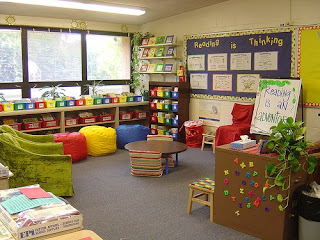
Here is my classroom now….
 

The two bottom-right shelves hold our TOG books. The others hold other subjects, manipulatives, and other teaching materials.

Aaaaah! Order has been restored!
 
Return soon for the next article in the Plan-It School series: Writing Objectives.

Friday, June 19, 2009

Plan-It School Series: Organizing Materials, Part One

Okay, so the books have all arrived, and now my house looks like this….


And this….


But I want it to look like this….*


Well, at least like this…


The first year we homeschooled, I nearly had a nervous breakdown trying to organize and keep track of books. First, finding shelf space for everything was tough. Then, it seemed like almost every day I could not find the books I needed when I needed them. I was an organizational train wreck. Over the years, I have learned to tackle these issues early and stay on top of them throughout the school year.

I begin by tackling the most difficult task of the year, imho… clearing out the previous year's books, materials, paper work, etc. My state requires that I create a year-end report for each of my children. I am not a strong record-keeper so I have to make this simple for myself.

During the school year, I place finished, graded assignments in my filing cabinet. I have one folder for each boy. I also take pictures of art work or larger projects that cannot be filed. At the end of each six weeks, I remove their papers from the file, and the boys and I sort through them. We keep samples of work from each subject. I let them help me decide what stays and what goes. I guide them through this process so that the best work stays but, at the same time, I value their input because it ensures I keep assignments that were meaningful to them. The "keep-it" work goes back into the file, and the rest goes to a grandma or to the garbage.

At the end of the school year, we place the work they decided to keep each six weeks into an expandable file. I also print pictures of projects and art and place them in the file. The filing cabinet is clean and ready for the next school year.

To complete my state's requirements, I also type a report on each boy. I write a short paragraph describing each of the following:

  • Subjects studied (I use the TOS 2009 Schoolhouse Planner's "End-of-Year Evaluation" form)
  • Grades earned (I use the TOS 2009 Schoolhouse Planner's "End-of-Year Report Card" form)
  • Mastered content
  • Areas of weakness
  • Strategies I intend to implement the next school year to address weaknesses
  • Extra-curricular work (TOS 2009 Schoolhouse Planner's "Extra-curricular Activities Log"
  • Special achievements

The 2009 Schoolhouse Planner has several forms that could be used for this record. I highly recommend it. I also include a copy of each boy's attendance report (the Schoolhouse Planner has a form for this too) and achievement test results. In my home state, homeschooled children are required to take a standardized achievement test every three years. I try to test mine every year as I think it is a helpful tool. I use the results to guide my planning for the next school year.

After this is complete, I remove books that we have completed from the shelves. I sort through these books and decide which ones will be needed again in the future. Of the ones I know will never be used again, I decide if I want to sell them or store them. I log the ones that I will be keeping, especially those that will be used again in a later school year, using the Schoolhouse Planner's "Homeschool Book Inventory". I store the books in numbered boxes. I write the box number where I will find each book beside its title on the inventory form. I try to sell the others at my local homeschool association's book sale. I list the ones that do not sell there on ebay.

Now, my shelves are clear and ready for next year's curricula. Return soon for Organizing Your Materials, Part Two in which I will share my system for labeling, logging, and shelving our books.

*image from http://www.flicker.com/

Wednesday, June 17, 2009

Plan-It School Series: Purchasing Materials

Once you have your goals in place and have selected your curricula, it is time for the daunting task of purchasing your materials. The two most daunting aspects of this task for me are keeping accurate records of my purchases and staying on budget.

I start by making a list. In fact, the "All-Purpose Wish List" from The 2009 Schoolhouse Planner is perfect. The three columns on this form provide a place for me to write in the names of the books I need as well as where I purchased them and the price I paid for each. I list my core items first like math texts and the Tapestry of Grace year plan I need. Then I look through TOG's book list and other supplemental lists and add anything I think I will need to complete our program. I know I will not be able to afford every item on this list so I write the necessities in red and the others in blue.

Once my list is in order, I purchase those items which must be bought new. For example, I have found it is very difficult to find good, used copies of Singapore Math, and they only cost about $7 each new from Sonlight. I strongly suggest that if you can buy something new for only a small percentage more than it would cost used, buy it new. The amount you would save buying used is not worth the headache you will incur seeking out a quality used book. Once I purchase these books, I write on my spreadsheet where I bought them and the price I paid for each.

Also consider if you can buy any of your curricula through a promotional sale. Check vendors' websites frequently. Put yourself on their mailing lists or subscribe to their newsletters. Find out if they offer discounts to new customers or to loyal ones. For instance, I bought my Tapestry of Grace year plan at a discounted price through a Tapestry Tea hosted by one of my friends for families new to TOG.

Next, I visit my library's website and search for books I need. I have to admit that I do not use the library often. First, many of the books found in our libraries do not support a Biblical worldview. It is difficult to find books, particularly non-fiction, that do not promote evolution, revisionist history, etc. Secondly, I am forgetful (Have I mentioned this before? I can't remember.) and end up paying as much in library fines as if I had purchased the book to begin with. Third, my local library is not large and does not always have the number of copies of a book needed to support the demand. I have found myself in a jam having to wait for ILL arrivals or for another dear mother to return the book I need. By the time it is available, we have moved on to a new topic.

Therefore, I consider a few things before I make the decision to borrow a book from the library. One, how many copies of this book does my library offer? If it seems that I will be able to get the book easily when I need it, I write an "L" on my spreadsheet under the "where to buy it" column. I make sure to note in my lessons plans when I will need to borrow it, too. Sometimes I make an exception and go for an inter-library loan or place holds on items if it will save me a substantial amount of money. Once again, I make a note in my lesson planner to reserve these books two to four weeks in advance.

I also consider the book's content. If I am searching for a specific title, like The Jungle Book, which will read the same from the library as it would from a Christian book seller, I borrow it from the library. If I am looking for a general book to support a content area, I am more careful. For instance, one year I needed a book on Jupiter for a science unit. All of the books on planets available at my library were written by an astronomer who promotes Darwinian evolution and panspermia. I do not want my children adopting his worldview so I purchased a more acceptable book elsewhere.

After I have made my library decisions and marked my spreadsheet accordingly, I shop at any local book sales available to me. My local homeschool association hosts a book sale each spring. It is not large, but each year I find a few things that I need at good prices. I bought two teacher's manuals this year for half of what I would have paid for them new. If you are just getting started on your homeschooling adventure, I suggest you join a local association and seek out your state's home education association. Ours hosts a large used book sale every year.

I follow up the book sales by purchasing the remaining books online. With my list beside me, I open three internet tabs, one for Ebay, one for Amazon, and one for a Google search. I search for my remaining red items first and then for blues as my budget allows. Comparison shopping is easy since I only have to click to move from store to store. I pay for all of my items after I have completed all of my shopping. If I have bought multiple items from a single seller, often shipping can be combined. As I shop, I fill in the information for where my purchases were made and the prices I paid on my spreadsheet.

Next I create an e-mail folder and name it "curriculum". I store all confirmations, receipts, shipping notices, etc. in this folder. I keep these records until all of my items have arrived. I place my spreadsheets with my purchase records in my planning folder. When an item arrives, I write an "R" in the margin of my spreadsheet beside its title if the book meets my expectations. If it does not, I review the listing information to make sure I am not at fault and then contact the seller immediately. When all items have arrived to my satisfaction, I go to the appropriate online markets and leave feedback. Then I delete all e-mails in my curriculum folder.

If there are items on my list that I could not find or could not afford, I turn to my homeschooling friends. The Lord has provided a number of times through a generous friend who was willing to loan us a book. However, we must exercise good manners when choosing to borrow from others. Books must not be kept too long and must be returned in the same condition as when they were loaned. I think one must be willing to loan as often as she borrows, too. Each time you receive a book, consider how blessed you feel and seek opportunities to bless others in return.

I have one final tip. I do not try to organize my books as they arrive because I have found this is too much to do at once. Instead I stack them in my classroom until I receive the last item on my list. Then I organize them accordingly. In case any of you may be getting the impression that I have it all together, here is a picture of what my classroom looks like when the books start pouring in. I hope you have a good chuckle, and it brightens your day.


Remember this lovely, organized, freshly-remodeled room?


Here it is now. What's that noise? Do I hear giggling coming through my computer?


To read about how I organize our books and return order to our classroom, return soon for the next article in the Plan-It School series, Organizing Your School Materials.

Tuesday, June 9, 2009

Plan-It School Series: Selecting Curricula

Choosing curricula can be one of the most exciting times of the year. I love when the packages arrive on my front stoop. It feels like Christmas with something new to open almost everyday. However, selecting from the wealth of options available can be overwhelming. How do we pick what is best for our families? I choose my curriculum similarly to how I choose a car.


The last time we bought a car, I was nine months pregnant. We knew that very soon our car would need to hold two car seats and other baby paraphernalia. Also, we lived in a rural area, far from work and shopping. We drove a lot which put finding a van that would get good gas mileage (at least good mileage for a van) at the top of our list. Our budget was limited, so affordability was extremely important. Given the hot summers we experience in the South, we considered air conditioning essential, and because I cannot drive a stick-shift, automatic transmission was non-negotiable. Last on my list was the color. I really like blue and green and wanted a van in a shade of one of those colors.


After we had listed what we wanted, we began to research. We talked to friends about their vans. We read Consumer Reports. We took a few models for a test drive. We found the van that was just right for us, with one exception. To get the price we needed, we had to buy the model on the lot… a RED one. I am not fond of red cars, but I had to admit that of all of our criteria, color was of least importance. We decided to concede on color preference and became the owners of a bright red mini-van.


We choose our curriculum in a similar fashion. Curriculum is a our educational vehicle, and it must get our children where we want them to go. That is why we set educational goals before purchasing curricula. If a curriculum does not meet certain expectations, it will not yield the results we want. If we do not know what our expectations are then we are bound to buy haphazardly and find ourselves dissatisfied in the end. During our "homeschool conference", we set these goals and use them to guide our choices.


After our goals are set, we research. That involves reading reviews and talking to homeschooling friends. The Old Schoolhouse Magazine's Homeschool Crew is a great review panel and offers free reviews on a number of homeschool products. The Homeschool Lounge is good place to chat with other homeschoolers. They even have a group called "curriculum" that serves as a forum for posting questions and discussing experiences. HomeSchool Reviews allows you to post your own reviews and read reviews written by other members. Membership is required but is free. Cathy Duffy also offers a number of product reviews. The Curriculum Choice is another great site. Not only do the contributing authors review products, they explain different schooling philosophies and provide links to sites where you can find more information on each approach.


However, my most valued reviewers are my homeschooling friends. Because they know me so well, they can offer me more insight. Frequently, a friend has said something to me like, "You would love this program. It fits your personality." or "I don't think you would be happy with ____. It just isn't your style." They are often right, too!


Next, we take a few test drives by ordering samples. Most suppliers offer a sample lesson that you can download for free . Others will send you freebies via snail mail or allow you a sneak peek online. Once again, I involve my friends in this process whenever it is appropriate. I am not shy about asking homeschoolers in my local association for their opinions. Most homeschoolers are happy to help each other and to discuss their favorite curriculum. Some have even loaned me materials long enough for me to peruse them and determine if they fit my needs.


In the end, we have to make some concessions. When we set our car-buying goals, we did not know that the only model available would be red. As fallible people, we cannot claim to have the wisdom to get everything right the first time… or ever, for that matter. Likewise, a perfect curriculum just does not exist. However, to help us exercise wisdom in making concessions, we have divided our goals into two categories, essential and non-essential goals. We have selected three essential goals and try our best never to compromise on them. They are providing a distinctly Christian education, developing a Biblical worldview, and promoting a strong work ethic. Non-essential goals can range from wanting a rubric for scoring writing to wanting lessons that are broken into small chunks.


I intend to write more on our goals later in a series on "socialization". As you read our goals, they may differ from yours. That is to be expected. Each family has different needs and must follow God's leading in meeting them. However, each of us has the same command… to raise our children in the discipline and instruction of the Lord. (Eph 6:4) Educating our children is a huge leg of our life's race. In 1 Corinthians 9, we are admonished not to run this race aimlessly but to run as one who wants to win with the self-control and training of an athlete. Ladies, I encourage you to take time this summer to reexamine your goals and I will reexamine mine. Let's seek the wisdom to set them well so that we might finish well, too.

Return soon for Part Three: Purchasing Materials

Tuesday, June 2, 2009

Creating a Schedule, Part II

Plan-It School Series

When I outlined this series, I intended to dedicate one post only to the topic of creating a schedule but realized I failed to write about an important aspect of school scheduling. Establishing your school calendar is an essential part of the process.

Michael and I decided early on to follow a year-round approach. Since he is a teacher and has two months vacation each summer, we take one full month off so we can enjoy time together as a family. That break also provides me time to gather and organize school materials. Our school year usually starts in July.

For the past three school years, I have organized our school content into six-week units followed by a two-week break following each unit. During the break, I solidify my plans for the next six weeks. However, this year we are switching to Tapestry of Grace which is comprised of four nine-week units, so we will break every nine weeks.

To determine next year's start date, I looked at December in my calendar. I decided which week would be our first week of Christmas break and I penciled in "18" on the week before. I then counted backwards labeling the preceding weeks until I reached 10. I labeled the two weeks that precede the "10" week as "off" then picked up the backwards count until I reached 1. I also labeled the week of Thanksgiving as an "off" week. I purposefully plan to take that week off to allow time for holiday preparations and to make a place for two make-up days if needed. On other holidays, like Labor Day, we complete an abbreviated school day.

Next, I looked back at December and into January and marked three weeks for Christmas break. I allow myself a little extra time then because the holidays are so busy and I know I will need a longer break in order to have time for all the celebrations and to get plans for the next unit in order. Then I marked weeks 19-27 and the next two weeks off, then weeks 28-36. I also penciled in any holidays and spring break. After week 36, I usually have 6 weeks before school must begin again.

This is the only system I have ever followed because it has worked so well for us. There are several pros. The breaks really help. It is nice to be able to take a slower pace and to get planning done in between units. These breaks also provide a buffer for the unexpected. Last year, I needed surgery and was able to schedule it during one of our breaks. This year, I needed four weeks off in the spring to prepare and clean up from the remodeling. The year-round school schedule gave me the freedom to do this without falling too far behind. (We did still fall a little behind... but not too far.) There are cons too. We do not get a full summer break. We have to do school a few weeks each year when friends are on their breaks. Conversely, several of our breaks take place while our friends are in school. In my opinion, the pros of this schedule do outweigh the cons.

However, there are many different ways to schedule your school year, and I suggest you do some research before you commit to a particular calendar. Talk to other homeschool friends and find out what they do. Read online about other's experiences. Remember that as a homeschooler you are not bound to the traditional school calendar. Just be sure to know the laws in your state governing homeschool and create a schedule that complies. Once you find a schedule that meets your needs, commit to it for one year. Know that you can change it if it doesn't work out for you.

After my calendar is marked, I prepare for keeping an attendance record. My state's laws require me to send a monthly attendance report to my local board of education at the end of each month. Since I am forgetful, I prepare in advance for this so I will be sure to send my reports in on time.

I use an attendance record available through my state's home education association's website. I print 11 copies of this form, one for each month I have school. The form has spaces at the top for personal information and a spread sheet beneath for marking the days each child completes school. I fill in all the information on the form, except for marking the days, in one sitting. I pin the form for the first month to a cork board in my classroom and put the other 10 forms in my filing cabinet. This puts the form I need daily at my fingertips and the others in a place I can find easily later.

I also address and stamp 11 envelopes and put them in my filing cabinet with the forms. At the end of the month, I remove an envelope and the next attendance form from the file and place the new attendance form on the cork board. Then I sign, photo copy and mail the completed attendance form. This keeps me from having to look for stamps, envelopes, the board of education address, etc. every month. I mark the copy "home record" and keep it in my file as a permanent record.

I have placed our 2009-2010 school calendar in my sidebar. Take a look and let me know what you think. Feel free to comment and share about the school schedule you follow, too. I look forward to hearing from you.

Blessings!
Dawn
Return soon for Part Two: Selecting Materials
I mean it this time! :-)

Saturday, May 30, 2009

Creating a Schedule

Plan-It School Series

I like to begin planning for the upcoming school year by reflecting on the previous year. I ask myself difficult questions. What really worked? What really didn't? In what areas do my boys need extra instruction? In what areas do they need more independence? What did we enjoy? What made us miserable? I pray about these things and answer with brutal honesty… no sacred cows allowed.

For example, my husband and I both love the study of foreign languages. We introduced our boys to Latin when they were in 2nd grade. It was our hope that they would both follow in our footsteps as linguists; however, one son demonstrated a real lack of interest. Latin nearly killed his joy for learning the year he studied it. It's true Latin promotes vocabulary development. It's true that there are tons of very successful classical homeschoolers who teach all of their children Latin. It's true that one day he will have to bite the foreign language bullet and study a foreign language whether he likes it or not. However, in an honest evaluation of that school year, we had to admit that Latin was not profiting him and removed it from his schedule.

After I have evaluated the previous year, my husband and I have what we call our "homeschool conference". This is a specific time we set aside for evaluation and goal setting. First, we pray together for wisdom and direction. Then we discuss many things. I share with him my evaluation of the previous year and I listen to his. We talk about how our children are performing academically. We talk about areas that need more or less attention. We discuss what subjects will be taught and how each subject fits into the overall vision for our homeschool.

Finally, we set goals for the next year. There are spiritual goals. What sin problems do we need to address more consistently? How will we strive to be more consistent in our teaching of the Bible and doctrine? There are academic goals. We decide which subjects each child will study… not what curriculum we will use, but solely what subjects will be studied. We also decide how many days per week each subject will be taught. Some are allotted five days, others only one or two. We make this determination based on how high of a priority that subject has.

After our goals are set, I estimate how much time each week will be given to each subject. I do this before I purchase curriculum so that our goals will guide my purchases. If we have decided that science needs to be given more attention, I will make sure my schedule reflects that. If I decide to teach science every day for thirty minutes per day, I won't buy a curriculum that is intended for two days per week . Or if I have a curriculum that I know I will use year after year, like Tapestry of Grace, I alter it to fit our goals, not vice versa. For example if world view is a priority, I will buy all of TOG's suggested materials. Meanwhile, if we determine that I spend too much time on history, I will buy only the required materials or less. It is not a perfect system and requires adjustments once my materials are acquired but it does set parameters that I find helpful.

Once I have made these decisions, I create a block schedule. The first block of time starts after breakfast and runs until snack time. The second is from snack to lunch, and the third is from lunch to the end of the day. I will list 3-4 subjects that are to be completed during each block. For example, if we have decided to allot about an hour and half for Bible and History and about a half an hour for Science, I put those three together in the two-hour block between breakfast and snack. Some days, Bible and History will only take an hour, so we take a break or do some chores during that block. I try to over-estimate the amount of time I will need so that I will feel ahead of schedule and not constantly behind.

I also think about which subjects one child can do independently while I work one-on-one with the other. For example, Orville can complete his Literature study without assistance which frees me up to teach math and spelling to Wilbur. I color code my schedule, highlighting Orville's activities in blue, Wilbur's in yellow, and those to be completed together in green.

Once I plug everything in, if I feel anxiety just looking at the paper, I re-evaluate and adjust. This means sometimes we decide to postpone teaching a topic or decide to teach it fewer days per week. You can read our schedule for the 2009-2010 school year in the sidebar.

Last but not least, I pray for the wisdom to use my schedule well. A schedule that is not put into practice is worthless. On the flip side, I pray for God to rule over me and my schedule and not for the schedule to rule. I acknowledge that unforeseen events will arise and I will have to adjust as needed. I pray for the grace to trust God when those times come and to be obedient, not frustrated. In the front of my planner I write the reminder, "Trust in the Lord with all your heart and lean not on your own understanding. In all your ways, acknowledge Him and He will make straight your paths." Proverbs 3:5-6

I am praying for each of you as you plan for the upcoming year. Let us trust the Lord and acknowledge Him as we plan and praise Him as He directs us in the way we should go.

Blessings,

Dawn

Return soon for Part Two: Selecting Materials
and visit Raising Olives for great tips for moms... Tuesday’s Tip for Mom is a blog carnival hosted at Raising Olives to allow moms to share what they have learned along the path of motherhood. Join us every Tuesday as we learn and share tips and ideas for spending time with, encouraging, training or relating to our children.

Friday, May 29, 2009

Read My Lips...Um....

Plan-It School Series

I have a huge personality defect. I have real trouble accomplishing anything without a very detailed plan. Allow me to illustrate….

In high school, I was a member of the forensics team. I competed in several events and was most successful in original oratory. At the beginning of the school year, I composed a ten minute speech, memorized it, and delivered it at various competitions. I brought home a first place trophy from almost every tournament. I excelled at O.O. because it afforded me think-time. I planned what I would say in detail and memorized it word-for-word which gave me the confidence to stand before my judges and speak with ease.

After a few months of wins in O.O., my coach decided I should try a new event. Since I had been successful as an orator and because I stayed on top of current events, she encouraged me to try extemporaneous speaking. I agreed to give it a try. Boy, was that a mistake!

Exactly thirty minutes before I was to deliver a 3-5 minute speech before a judge, I had to draw the topic for the speech from a hat. I will never forget the first topic I drew. This was during George H. W. Bush's first campaign for president. (I just dated myself, didn't I?!) I was given the task of explaining his plans for education reform. The rules allowed me to use any source I had brought with me (which was none) or any that was available in the library of the host school. I found no sources pertaining to the topic... absolutely nothing!

I nearly had a nervous breakdown. I was a Young Republican and had closely followed Bush's campaign but being put under a time constraint made me forget anything I may have previously known about him. The longer I unsuccessfully looked for a source, the more jumbled my thinking became. I stood before the judge with nothing, seriously, nothing to say. However, determined not to give up, I started my "speech" anyway.

"Vice President… George… Herbert… Walker… Bush (at least I remembered his full name)… is being hailed… the education… um… candidate. Should George… Herbert… Walker… Bush… be elected… he will (Think, Dawn, think! What will he do?)… he will need to tackle… the issue of… um… education reform. George… Herbert… Walker… Bush (Whew! I'm glad his name is long. This is adding at least a minute to my speech) could be the president… to lead us … to better… um… schools. George… Herbert… Walker… Bush…. um… um… um…."

That's where the judge stopped me.

"You have no idea what you're talking about, do you?" he asked.

"Not a clue," I replied.

"Yeah, " he continued. "I'm going to have to stop you because if you say 'George Herbert Walker Bush' one more time, I may have to scream."

I thanked him for his patience and quickly exited the room, making a beeline for my coach. I told her what had happened and declared that I would never, ever participate in extemporaneous speaking again! Later in the day, after I had time to think, I realized many things I could have said in that speech.

I learned from that experience that I require think-time. I cannot do things off-the-cuff. Over the years, I have also learned this applies to my teaching as well. Without a well-laid plan, I crash and burn. I take pains with my pre-planning because I really must. As a result, people are often curious about how I prepare for school. In fact, I have recently received e-mails asking for advice in this area.

As not to disappoint my loyal readers, this is the first entry in my Plan-It School Series. I complete most of my school plans over the summer and intend to write about each step of my process as I complete it for the '09-'10 school year. I hope many of you will join me and will feel free to share some of your planning tips as well.

However, as you read about my system, keep in mind that I tend to over-plan. Please, feel free to take from this series what will work for you but feel equally free to leave behind what won't. In return, I will give myself plenty of time to think before I write so that I won't start rattling off any long presidential names. :-)

Return soon for Step One: Creating a Schedule.